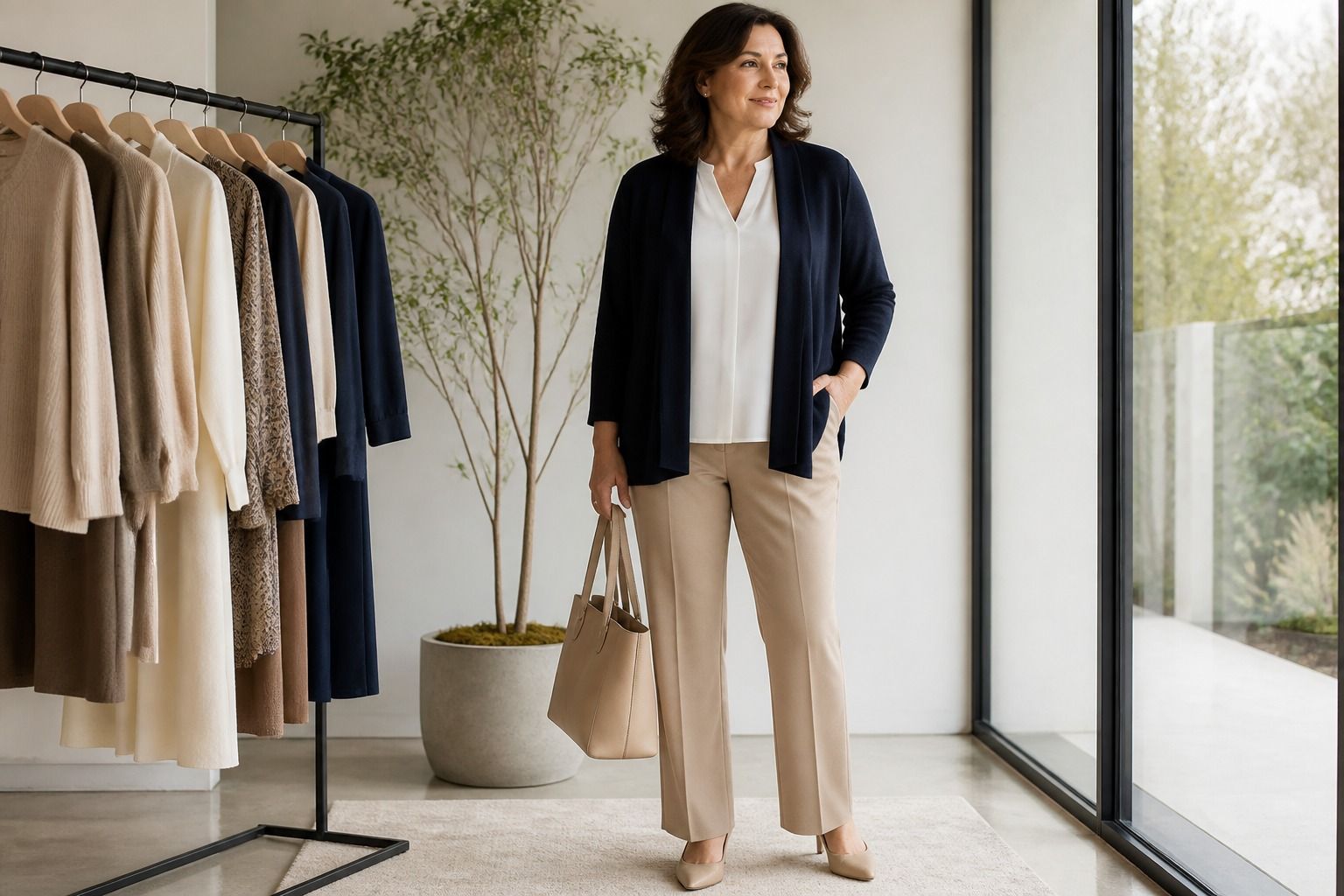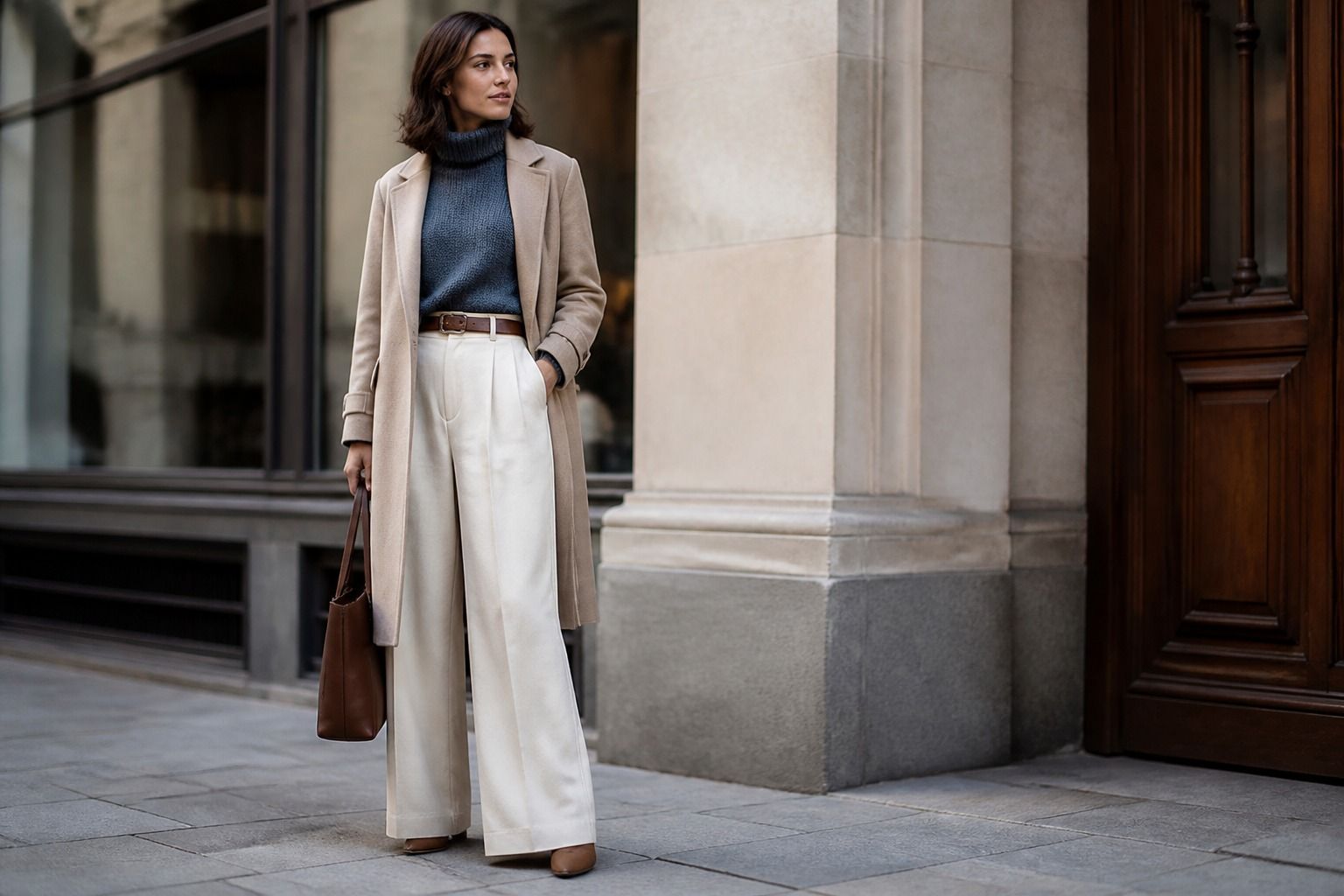
Style essences are a useful answer to a familiar dressing problem: a silhouette can fit beautifully and still feel unlike you. One person wants a clean blazer softened by an antique-looking earring; another wants the same blazer with trainers and a heavy canvas bag. Essence language gives those choices a name, but it should stay a creative tool, not become a new set of rules.
Body shape and style essence answer different questions
Body-shape systems deal mainly with proportion, fit, and the line created by clothing. Style essences deal with the personality of the finished image: sharp or relaxed, polished or playful, delicate or dramatic. A wide-leg trouser may work because its volume and length sit well on your frame. Whether you pair it with a silk blouse, a striped tee, or an oversized knit is where essence often appears.
Learn the common essence vocabulary without treating it as a test
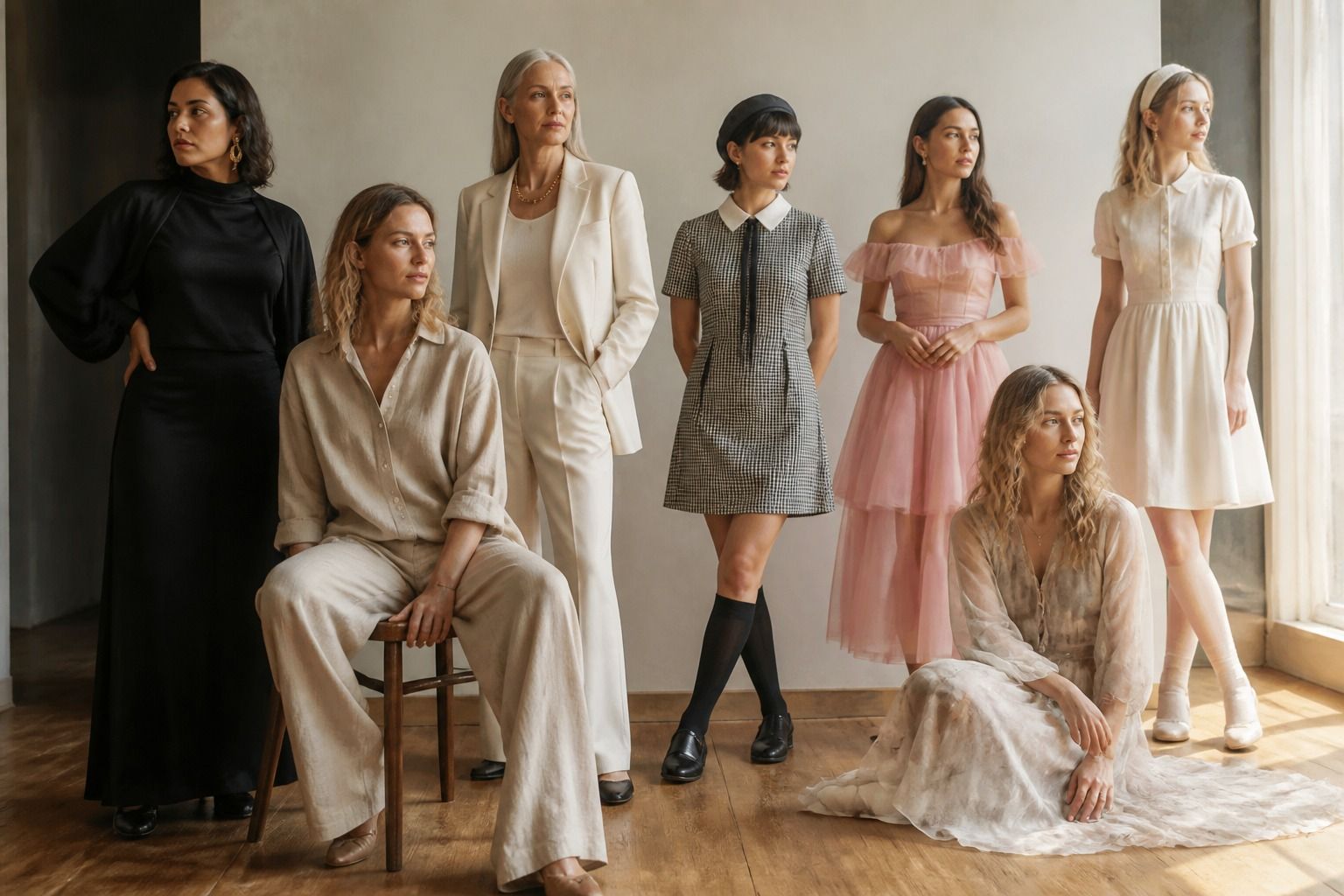
Dramatic often reads as elongated, high-contrast, crisp, or deliberately bold. Natural brings ease, texture, openness, and a touch of the outdoorsy or unfussy. Classic tends toward symmetry, polish, and moderate scale. Gamine adds contrast, compactness, a graphic edge, or a mischievous interruption to an otherwise simple outfit.
Romantic leans into softness, rounded detail, shine, and close, fluid shapes. Ingenue is often described through small scale, sweetness, and youthful detail, while Ethereal suggests lightness, elongation, translucency, and a slightly otherworldly mood. These are visual languages, not personality tests. A quiet accountant can enjoy Dramatic jewellery; a cyclist can prefer Romantic fabric. The words describe an outfit’s effect, not a person’s worth or behaviour.
| Essence cue | Small way to test it |
|---|---|
| Dramatic | Try a long clean coat, a graphic earring, or a strong light-dark contrast. |
| Natural | Compare linen, brushed cotton, and relaxed leather with smoother finishes. |
| Classic | Test balanced scale, neat fastening, and one restrained accessory. |
| Gamine | Add a cropped layer, a sharp collar, or a playful contrast in colour. |
| Romantic or Ingenue | Try curved detail, a smaller print, soft sheen, or delicate jewellery. |
| Ethereal | Test a long sheer layer, pale tonal colour, or gently flowing movement. |
Find evidence in outfits you already reach for
Before taking a style essence quiz, pull out six outfits you have worn willingly, not six you think look impressive on a hanger. Photograph them in daylight and make notes about their repeated details. Perhaps every favourite look has visible texture, an open neckline, and medium-sized metal jewellery. Perhaps your best outfits rely on one clean colour field plus a small humorous detail.
Look at the accessories as closely as the clothes. A person may wear plain trousers and shirts but consistently choose ornate rings, rounded bags, or bright socks. That is not inconsistency; it is often the clearest clue. Also notice what drains an outfit of energy. If stiff collars, tiny ditsy prints, or very delicate chains always feel costume-like, the pattern matters more than a flattering online collage.
Combine two or three essences in a usable way
Most satisfying wardrobes are mixtures. Rather than trying to make every item represent all of your personal style essences, assign each garment a role. A Natural base might be loose denim, a textured knit, and a roomy coat. Classic can enter through a tidy watch and a structured shoe. A Dramatic note might be a long pendant or a black-and-cream contrast. The outfit stays readable because each element has space.
Use proportion to decide how much of each note you want. Two dominant essences may need a quieter third one. For example, a floaty Ethereal dress with very sweet Ingenue bows can become overly precious if every accessory repeats the same message. A simple leather boot or plain coat gives the eye somewhere to rest. Think of an outfit as a conversation, not a checklist that must be completed.
Test detail, texture, and print before buying a new category
Essence experiments do not require a dramatic wardrobe overhaul. Roll the sleeves of a tailored shirt, change a shiny hoop for a matte sculptural one, or layer a soft scarf over a severe coat. Try the same dress with a small neat bag and then a slouchy textured tote. These low-cost swaps tell you whether the missing ingredient is scale, finish, or contrast.
Print is especially revealing. Put a small floral, a clean stripe, and a large abstract pattern next to the same plain trousers. Stand back far enough to see the whole look. A print that is lovely up close may become visually loud at your natural viewing distance. Keep a note of the scale that feels present but not distracting; it is more useful than memorising an essence chart.
Keep the framework from overprescribing your wardrobe
The risk with style essences is replacing one rigid system with another. You do not need to prove an essence in every outfit, and you do not need to avoid a favourite item because a quiz did not predict it. Context changes the equation: a wedding, a rainy commute, a work presentation, and a weekend market all ask for different levels of polish and drama.
Use the framework when it helps you make a specific choice. If an outfit fits but feels flat, add one essence cue. If it feels busy, remove one. Over time you may find that your personal style essence is less a fixed blend than a range you move through. That flexibility is not a failure of the system; it is what makes a wardrobe feel lived in.
A good final check is recognisability. When you look at a new combination, can you see a version of yourself in it before you can name the theory behind it? If the answer is yes, keep the note. If it only works when explained through a complicated blend, leave it as an interesting experiment. A useful wardrobe does not need a curator standing beside it; it should make sense to you on a busy Tuesday morning.
Essence language is also useful when you are editing rather than buying. Suppose a black dress fits perfectly but feels too stern for dinner with friends. You might soften it with a rounded shoe, a textured cardigan, or a small luminous earring instead of abandoning the dress. Or a soft outfit may need a crisp belt and a clean bag to feel finished. Photograph the before and after versions side by side. The difference is often easier to see there than in a mirror. Over time, these edits reveal which contrasts make you feel awake and which additions merely create clutter. That is a much better foundation for personal style than chasing a fixed percentage of any essence.